
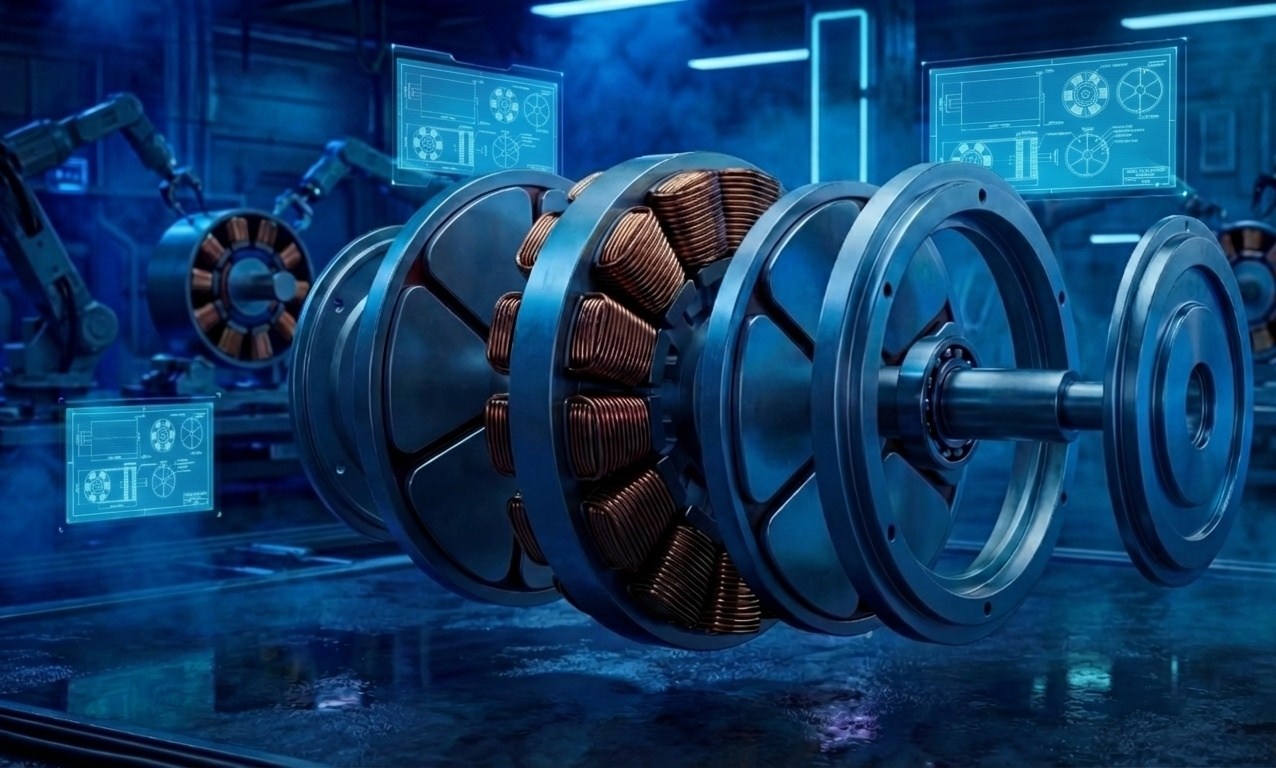
Why Axial Flux Motors Are Actually Taking Over
You’ve probably heard the claim: “Axial flux motors are revolutionizing everything.”
Here’s the reality and it’s even more compelling than the headline.
The Core Reason: Physics Wins
Radial flux motors have owned the market for 100 years because they’re good enough. But “good enough” doesn’t win when the world demands:
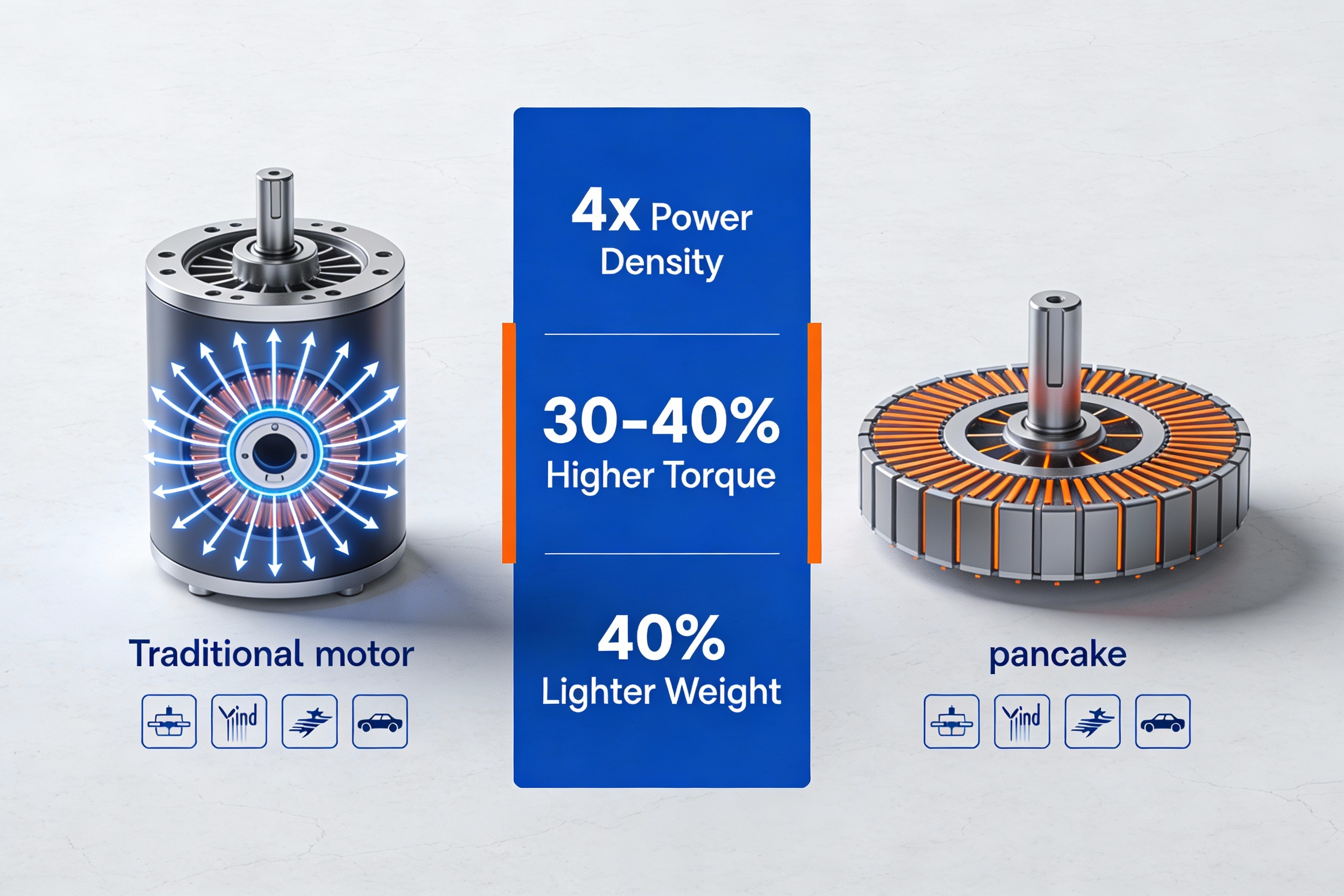
- 4x more power in the same footprint
- 30-40% higher torque in a lighter package
- 40% weight savings in vehicles where every pound tanks efficiency
Axial flux motors deliver all three simultaneously. This isn’t marketing it’s thermodynamics and electromagnetic efficiency that radial flux simply cannot match.
Why Now? Why They’re Actually Taking Over
The EV Inflection Point
Tesla didn’t just pick axial flux randomly. Electric vehicles have fundamentally different requirements than gas engines:
- Traditional motors waste space → EV designers need every cubic inch for battery
- Weight directly = range → Every kilogram matters
- Efficiency compounds over millions of miles → Marginal gains become massive savings
Radial flux motors were optimized for 1920s manufacturing constraints. Axial flux motors are optimized for 2025 realities. When EVs represent >50% of vehicle production (happening now), the demand switches overnight.
The Military and Aerospace Effect
Weight savings in aerospace isn’t a luxury it’s mission-critical. Every pound of motor weight is one less pound of payload or fuel. The U.S. military has already standardized on axial flux for next-gen systems. When defense contractors move, commercial markets follow.
Formula E switched to axial flux. Military drones use them. SpaceX components use them. These aren’t fringe applications they’re the bleeding edge moving mainstream.
The Manufacturing Bottleneck (It’s Getting Solved)
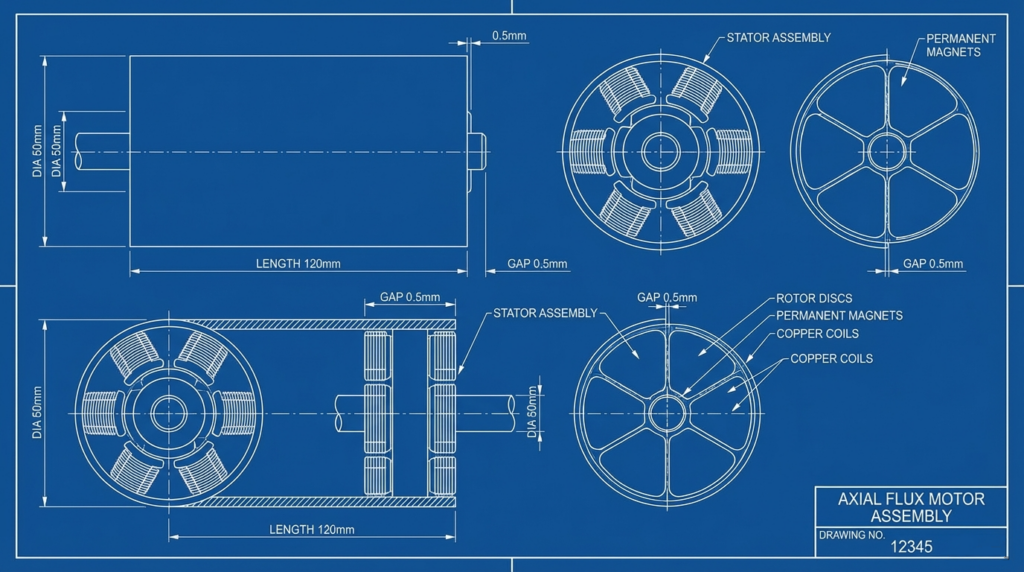
The reason axial flux didn’t dominate earlier: they’re harder to make. Radial flux motors are straightforward stamped steel and simple assembly.
But here’s what’s changed:
Advanced CNC capabilities are now commodity-level
Magnet technology has improved dramatically
Production volumes from EV manufacturers justify retooling
AI-assisted design optimizes geometry in ways manual design never could
We’re at the inflection point where manufacturing complexity is no longer the limiting factor. Efficiency and performance are.
Real-World Adoption (Not Hype)
This isn’t theoretical:
Tesla Model 3 Performance – Axial flux in rear motor
Porsche Taycan – Dual axial flux motors
Lucid Air – Axial flux architecture
Wind Turbines – Axial flux direct-drive systems (10+ MW generators)
Aerospace propulsion – Military and commercial programs
These aren’t startups experimenting. These are trillion-dollar industries making permanent architectural decisions.
The Real Game-Changer: Multi-Rotor Axial Flux
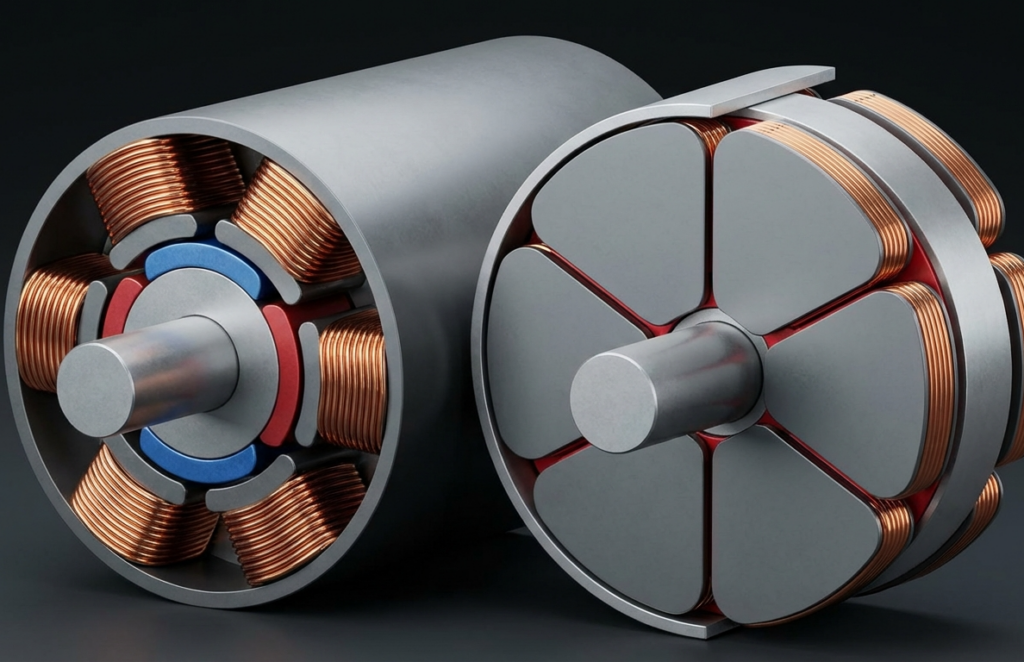
Single-rotor axial flux solved the compact problem. But multi-rotor designs in a single case solve the next problem: combining performance at scale.
Instead of stacking multiple motors (requiring multiple controllers, multiple cooling paths, synchronization complexity), multi-rotor axial flux delivers:
✓ Single controller = lower cost, higher reliability
✓ One cooling path = better thermal management
✓ Higher combined torque and efficiency
✓ Hybrid magnet configuration = more usable flux, less wasted windings
This solves the final engineering constraint that kept axial flux niche. Scale becomes viable.
Why This Matters For Your Industry
If your business touches:
Electric vehicles or propulsion – Architecture is shifting
Renewable energy – Wind turbines standardizing on axial flux
Robotics or automation – Compact, high-torque beats heavy and slow
Aerospace or defense – Already committed to the transition
Your supply chain, your motor specifications, and your cost models are about to change. The transition isn’t coming—it’s happening now.
The headline “Axial flux is taking over” isn’t hype. It’s the natural outcome of physics, manufacturing capability, and market demand finally aligning.
The question isn’t whether axial flux will dominate. It’s how fast your industry adapts.