

A modern API surface for anomaly scoring, conjunction prediction, maneuver planning, and thermal-aware constraints. These are the same patterns you’d use to integrate with Space Force, NASA/ESA ground systems, or commercial constellation control.
Debris avoidance
Detect debris, compute safe burns, push signed maneuver certificates to the control bus.
Fuel-aware maneuver delegation
When one satellite is low on fuel, SatFlight delegates the maneuver to a healthier neighbor and flags the original as “passive.”
Kessler pre-trigger prevention
For breakup events, schedule synchronized burns across multiple spacecraft to avoid cascades.
Real-time anomaly detection
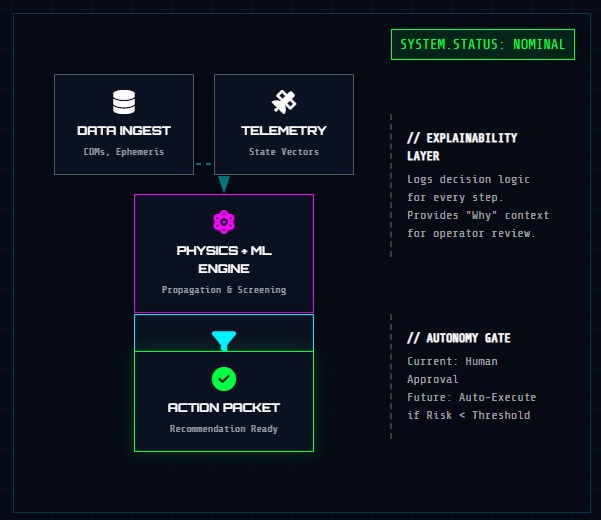
SatFlight continuously evaluates orbital states, TLE updates, telemetry, attitude, and thermal behavior to flag drift, degraded performance, or suspicious proximity before they become mission problems.
Conjunction prediction and risk ranking
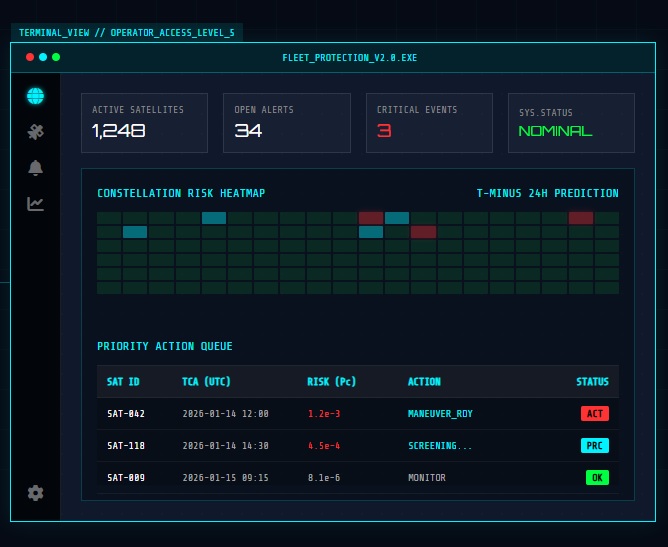
SatFlight parses dual TLE inputs, propagates orbits with precise models, and classifies conjunctions from nominal to critical so operators can focus on the few threats that matter.
Autonomous maneuver guidance
Using Δv estimation, orbital geometry, and thruster characteristics, SatFlight recommends burn direction, attitude profile, and transfer options output as PDF certificates for operators and JSON for automation.
Neuromorphic Flight Autonomy
Thermal and health-aware protection
Thermal and power telemetry are scored alongside orbital state, so SatFlight avoids maneuvers that would overheat or overstress the spacecraft.
Schema validated, event-driven data layer
Built on schema validation and event streams, SatFlight ensures telemetry and orbital messages are consistent, typed, and audit-ready across the constellation.